· Programming · 13 min read
The Scaling Problem: Why 3 Levels Isn't Enough
Every gym runs into the same problem. Not programming. Not coaching. Scaling. Here's why 3 options can't serve 15 different athletes, and what a 7-level system changes.
Every gym in functional fitness runs into the same problem: scaling.
Not programming quality. Not coaching talent. Not member motivation. The problem is delivering that programming to a room full of people who are nothing alike.
You have a class of 15 people. A 22-year-old former college athlete. A 55-year-old who started training six months ago. A 35-year-old who has been at it for three years. A brand-new member in their first week.
The whiteboard says the same thing for everyone: Rx, Scaled, or Beginner.
Three options for the entire spectrum of human fitness. And somehow, that is supposed to work.
Here is the thing. Statistically, your gym is not made up of 22-year-old former college athletes. The overwhelming majority of your community looks like the 55-year-old, the 35-year-old, and the brand-new member. They are the people paying your rent.
And yet most programming follows the old rule: program for the best, scale for the rest. Rx is the reference point. Everything else is a subtraction from it. Your programming is designed for the top of your gym, and everyone else gets a watered-down version that was never built for them.
That is not serving your members. And members who are not served well do not stay.
What Your Coaches Are Actually Doing
Here is what happens in a mixed-ability class.
The workout goes up on the board. Three options. Your experienced coach looks at it, looks at the class, and starts making adjustments in their head. They know Sarah needs a lighter barbell but can handle the gymnastics. They know Mike's knee can't take box jumps. They know the new member in the back looks nervous. A decade of coaching has built their internal scaling system, and they run it live, every class.
Now picture your newer coach. The one who finished their cert six months ago, knows the movements, means well. They read the board and start building their own scaling system from scratch. Different inputs, different instincts, different calls.
That is the scaling problem. Both coaches are scaling from memory. Both are doing it alone. Their calls do not stack -- because there is no shared page.
It is not a coaching failure. Consistent scaling across 15 different bodies, every class, every day, is one of the hardest jobs in coaching. The fitness industry has never built a real tool for it. "Scale as needed" is not a tool. It is a shrug.
Even great coaches cannot stay consistent with each other when each one is building the scaling system on their own.
What 3 Levels Misses
Think about the range of athletes who land in "Scaled."
That category includes:
- The intermediate member who can do moderate-load cleans and regular pull-ups but is not ready for chest-to-bar
- The newer member who is still learning clean technique with light weight
- The 60-year-old who can do ring rows and needs a lighter barbell
- The member rehabbing a shoulder who needs to avoid overhead entirely
All four of those athletes have completely different needs. They are all "Scaled."
And "Beginner"? That is an even wider net. The person in week one and the person in month three are both "Beginner," but they need completely different things.
Three categories for infinite variety. Every coach closing that gap on their own -- no shared page, no calibrated target. When the call misses, members end up doing workouts that are too hard, too easy, or flat-out inappropriate for where they are.
And then they leave.
The Consequences Nobody Talks About
When scaling breaks down, three things happen.
1. Beginners get overwhelmed. They look at "Scaled" and it is still too much. They look at "Beginner" and feel patronized. They spend the first few weeks confused, sore in the wrong way, wondering if this is really for them. Many do not make it past month two. Not because they are lazy, but because the workout did not meet them where they were.
2. Veterans plateau. They have been doing Rx for two years. The movements are the same. The loads do not challenge them anymore. Progress feels invisible. They keep showing up out of habit, but the spark is gone. They start looking at other programs, other gyms, or just fade out.
3. Coaches burn out. Every class, every day, your coaches are carrying the scaling system in their heads. No shared page. No calibrated target. Even for great coaches, it is exhausting. And when your best coach takes a day off, whatever they had built has to be rebuilt by the next coach.
None of these show up as a single dramatic failure. They show up as slow attrition. Members who "just got busy." Coaches who "needed a change." A retention number that looks fine monthly but tells a different story annually.
If your members cannot come back the next day, something went wrong. And more often than not, what went wrong is scaling.
Imagine a Different Whiteboard
Imagine a whiteboard that did not say "Rx / Scaled / Beginner." Imagine it showed exactly what to do at every level of development.
That is the idea behind 7-level programming. Instead of three broad categories, every workout is written at seven distinct levels. Each level has specific movements, loads, and complexity calibrated for that stage of development.
We call them White, Yellow, Orange, Blue, Purple, Brown, and Black.
Your White level member sees ring rows and dumbbell movements. They are learning patterns, building consistency, staying safe. There is no failure in these workouts because failure is not productive at this stage.
Your Orange level member sees moderate barbell work and bodyweight progressions. They are building capacity, adding load, learning timing.
Your Blue level member sees full movements at moderate intensity. Pull-ups, power cleans, double-unders. They are putting it together.
Your Purple and Brown level members see competition-ready and advanced variations. Chest-to-bar pull-ups, heavier loading, higher complexity.
Every member knows exactly what to do. The coach is not carrying the scaling system alone. The workout arrives already scaled. They coach, which is what they are there for: cues, energy, relationships, safety.
And here is why this is not just "more options."
Why More Levels Works (It Is Not Just Granularity)
The objection is predictable: "Seven levels sounds complicated. We keep it simple with three."
Three levels is not simple. Three levels pushes the complexity onto the coach. They have to solve the scaling puzzle every class, for every athlete, in real time. That is not simplicity. That is hidden complexity.
Seven levels makes the complexity visible and solves it once, systematically. The workout arrives with scaling built in. The coach reads the level, delivers the workout. The system did the hard work before class started.
It is the same principle behind any good system. A restaurant with three menu items is not simpler to run than one with twenty.
The Data Behind the Levels
These 7 levels were not invented in a conference room. They were not designed by a single coach based on their personal experience.
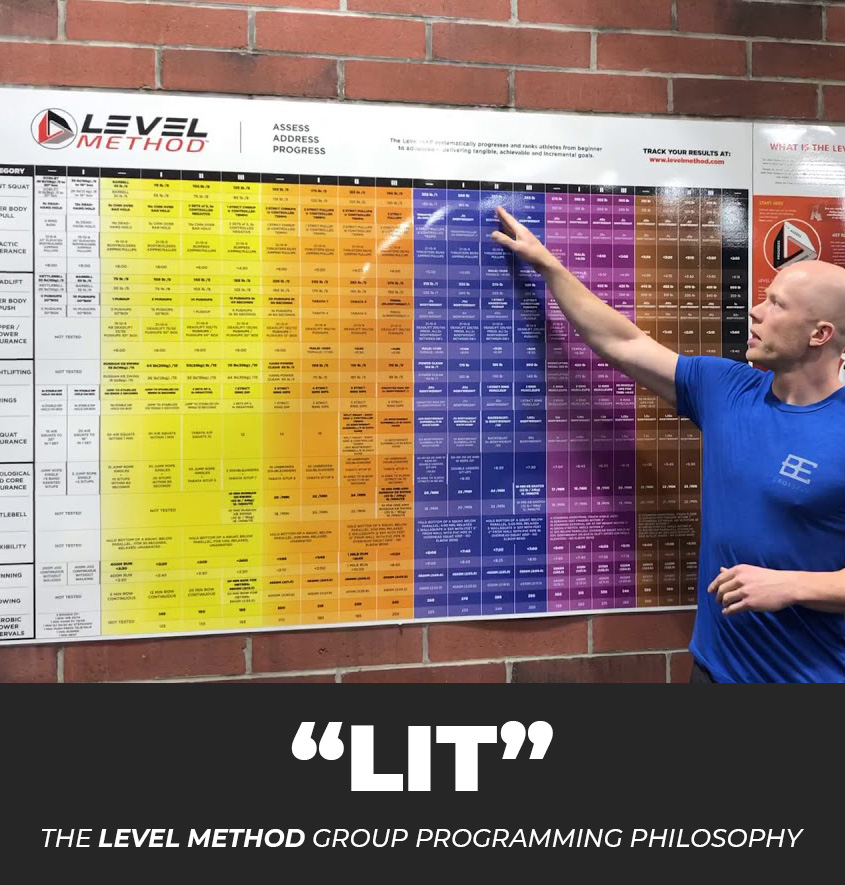
Level Method's levels are built on an assessment system that uses 15 foundational categories, from front squat to upper body pull to cardiovascular endurance and core, each with calibrated thresholds that define what each level means in that category.
Those thresholds have been refined across 1.8 million data points from over 1,000 gyms over 10 years. When the system says an athlete is at a certain level for a specific category, it is not an opinion. It is calibrated against what thousands of real athletes have performed at that stage.
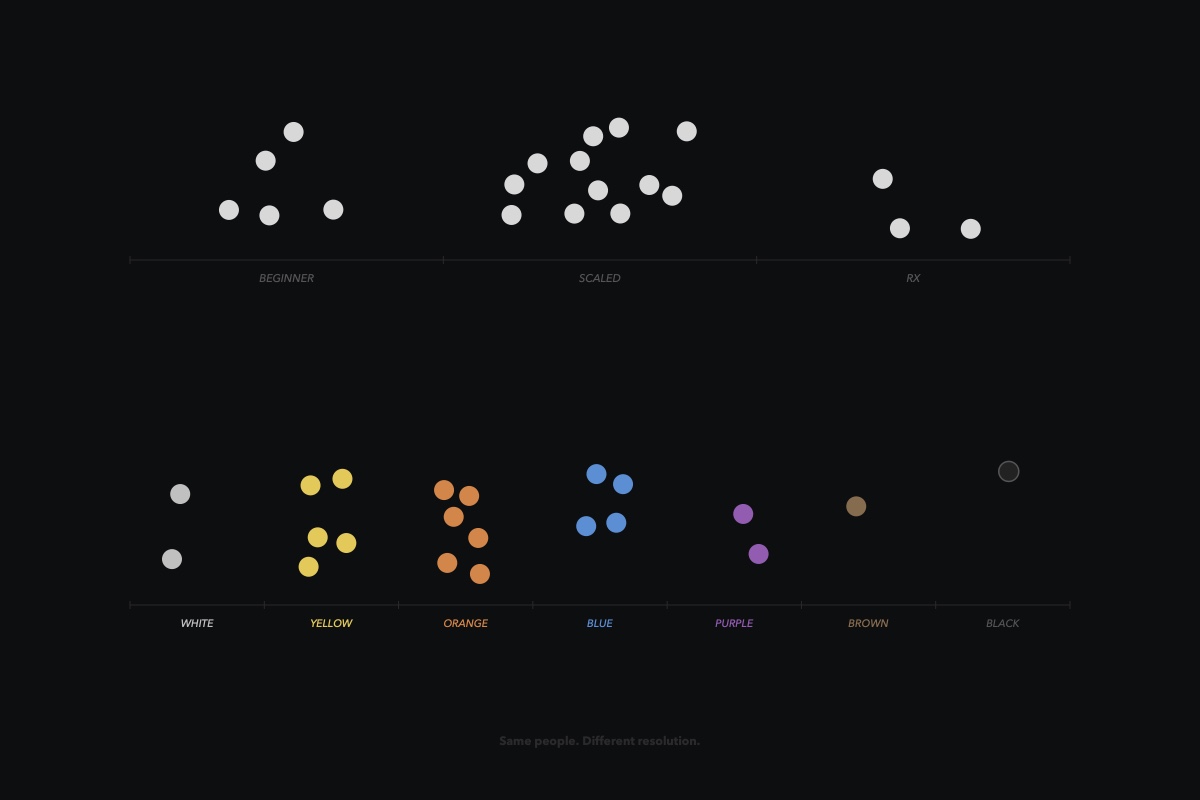
And here is what the data shows: 80% of gym members fall between White and Orange level. The vast majority of your gym is in the early and middle stages of development. Yet most programming is built from the top down: Rx is the standard, and everything below it is an afterthought.
Programming 7 levels allows your gym to equally serve the full distribution, not just the top 20%.
The system keeps getting more accurate, too. Every gym that uses it, every assessment logged, refines the model. This is not a static chart. It is a living dataset that gets sharper over time.
That is what separates leveled programming from "we just wrote seven versions of the workout." Anyone can write more options. The question is whether those options are calibrated to anything real.
The Scaling System Should Live in the System, Not a Head
Here is the part gym owners feel but rarely say out loud.
Right now, the scaling intelligence in your gym lives in one place: your best coach's head. Built over years. Earned through thousands of classes. It is real, and it is irreplaceable -- because no one has ever written it down.
And because it lives in one head, it does not spread. Your newest coach cannot read it. Your second-best coach cannot run it on the days your best one is out. If that best coach ever moves on, what they built goes with them.
That is not a coach problem. That is an industry problem. The tools to capture, calibrate, and share scaling intelligence have never existed in fitness.
One gym had a member named Nicole. Blue level. Had the running record for monthly attendance three years in a row. Dedicated, consistent, knew the system inside and out. She was not a technical coach. She had not spent years studying programming. But she wanted to start coaching.
With our system, she could. We provide coaches notes for every day. She would read through the coaches notes before class. She understood how the levels worked. She could look at a member's data and say with confidence, "Here is your version of this workout." From day one.
Not because she memorized every athlete. Because the scaling system lived in the system -- and she was now running it, same page as everyone else on staff.
That is what "systems over talent" means. It does not mean talent does not matter. Your veteran coaches get sharper when their judgment compounds onto a shared page instead of living alone in their head. Your newest coach walks in with the answer your best coach spent years building. Everyone scales from the same calibrated starting point, and then layers their own coaching on top.
But 7 Levels Is Just the Surface
Here is what most people do not realize.
When athletes open their workout, they do not just see "do the Blue version." They see individual scaling tags on specific elements within the workout. Their pull-up level might be Blue, while their front squat level may be Purple and their core might be Orange.
That is because the system does not just assign one level to a person. It scales each element of the workout independently, based on that athlete's assessed data in the matching category. An athlete might be at one level overall, but their upper body pull is behind and their squat strength is ahead. The workout reflects that, element by element.
This is per-element scaling. It is the layer beneath the 7 levels that makes the system fundamentally different from anything else in the industry. Not more options. A different architecture entirely.
We will go deep on how this works in a separate piece. For now, know this: what you see on the surface, 7 levels instead of 3, is already a massive improvement. What is happening underneath is where it gets truly powerful.
What This Means for Your Gym
If your gym runs mixed-ability classes, and almost every gym does, the scaling problem is costing you in ways that do not show up on a spreadsheet.
Members who leave after two months because they never felt like the workout was for them. Coaches who burn out trying to be everything to everyone. Class quality that shifts every time the coaching staff rotates, because each coach is running their own scaling system. A vague feeling that something could be better, but the programming is fine, so what is it?
It is scaling. It has always been scaling.
The fix is not better coaches. It is not better programming. It is a better system for delivering each member an individual workout drawing from their proven capabilities.
See what 7 levels looks like on a real workout. Download "One Workout, 7 Ways," a single workout written at all 7 levels with coaching notes. Get the free guide →
Ready to see the full system? Book a discovery call → and we'll walk through how 7-level programming works in your gym.
Level Method has been building leveled programming since 2016. Over 1,000 gyms. 1.8 million data points. 10 years of calibration. Learn how it works →
Frequently Asked Questions
What is the scaling problem in gyms? The scaling problem is the gap between programming quality and programming delivery. Most gyms write good workouts but only offer three scaling options (Rx, Scaled, Beginner) for a class of athletes with completely different abilities. Each coach closes that gap on their own, from memory, with no shared calibrated reference. The result is members getting workouts that are too hard, too easy, or inappropriate for their stage of development.
What is leveled programming? Leveled programming is a system where every workout is written at 7 distinct levels, each calibrated to specific performance thresholds. Unlike Rx/Scaled/Beginner, each level has defined movements, loads, and complexity appropriate for that stage of development. Level Method's 7 levels are White, Yellow, Orange, Blue, Purple, Brown, and Black.
How many levels does Level Method have? Level Method uses 7 primary levels: White, Yellow, Orange, Blue, Purple, Brown, and Black. Each level is further refined across 15 foundational categories, creating per-element scaling that adjusts each part of a workout independently based on the athlete's assessed data.
What is per-element scaling? Per-element scaling means the system does not assign one level to a person for the entire workout. It scales each element independently. An athlete's pull-up level might be Blue while their front squat level is Purple and their core is Orange. The workout reflects each element individually based on assessed data in the matching category.
Why is Rx/Scaled/Beginner not enough? Three categories attempt to cover the entire spectrum of human fitness. 80% of gym members fall between White and Orange level, yet Rx is the reference point and everything below it is an afterthought. The result is beginners getting overwhelmed, veterans plateauing, and coaches burning out trying to solve a scaling puzzle that has no written answer.