· Level Method · 8 min read
The Member's Guide to Level Method
If you train at a Level Method gym, your workouts have a level on them. White, Yellow, Orange, all the way up. This is what that actually means for you.

If you train at a Level Method gym, your workouts have a level on them. White, Yellow, Orange, Blue, Purple, Brown, Black. Maybe a number next to a color. Maybe a tag on the whiteboard or in your gym's app.
You've probably wondered what it actually means.
This guide is for you. The person doing the training. Not the gym owner, not the coach. You.
In the next few minutes I'm going to walk you through what your level is, what the MAP is, why your workout isn't really "the Blue Level workout," and how to read your own progress better than the whiteboard ever could.
I run the company that built the system your gym is using. We've spent ten years and 1.9 million data points across 1,000+ gyms figuring out how to scale workouts to actual humans, not three buckets on a whiteboard. None of that is the point of this guide. The point is: you are the human the system is built to serve, and you should know how to read it.
Why 7 Levels, and Not 3
Most gyms in the world give you three options for any workout: Rx, Scaled, Beginner.
Three options for the entire spectrum of human bodies.
Think about that. The 22-year-old former college athlete and the 55-year-old desk worker who started training six months ago land in the same Scaled column. The mom coming back from a third pregnancy and the high school basketball player gearing up for season: same column. They're not the same fitness level. They're not close. But the whiteboard treats them the same.
Three buckets is what the industry has had for as long as group fitness has existed. It's not anyone's fault. It's just the tool everyone inherited.
Seven levels is more useful because there's actually somewhere accurate for you to be. Whatever your training age, whatever your background, whatever your strengths and weaknesses look like, you're going to land at a real coordinate, not in the middle of a column with everyone else who didn't fit the elite version.
Your level is not a verdict. It's a measurement. The first thing you should know about it is: it's information, and it gives you a clearer read than a broad label like Rx or Scaled.
What Your Level Actually Means
Most members are White Level through Orange Level. About 80% of the people training in our system are in that range. Another 18% are Blue through Brown. Fewer than 1% reach Black or above. That distribution isn't a competition tier list. It's what humans look like.
If you're White, Yellow, or Orange in a category, that's not a bad place to be. That's where most members actually are, and it's where a huge amount of useful training happens. White through Orange is where most of the work is. Most of your gym is there. Most members are quietly building real fitness in that range and have been for years.
Blue Level is strong. Purple is strong-strong: the kind of person who's been training seriously for a long time and it shows in how they move. Brown is rare, Black is rarer than that, and fewer than 1 in 2,000 members ever reach Red.
The point of the levels is not to make you climb to Black. The point is to give you a real read on where you are and what the next step looks like.
If you've been told "you're Scaled" for a year, you don't actually know what you are. Scaled covers an enormous range of capability. Your level is supposed to tell you something specific. White moving toward Yellow looks different from Orange moving toward Blue. The training, the cues, the load, the next milestone: different at every step.
Your level is information. Not a judgment. Not a finish line.
The MAP: Your Fitness Fingerprint
Here's where it gets interesting.
You don't have one level. You have a constellation of levels across categories.
Your gym is measuring you across multiple movement and energy categories. Squat. Deadlift. Push. Pull. Rowing. Gymnastics. Maybe more, depending on what your gym has built into their MAP.
You might be Orange Level on your deadlift, Yellow Level on your rowing, and Blue Level on a more technical gymnastics category. That's an actual profile, not a contradiction. That's what most people actually look like under the hood.
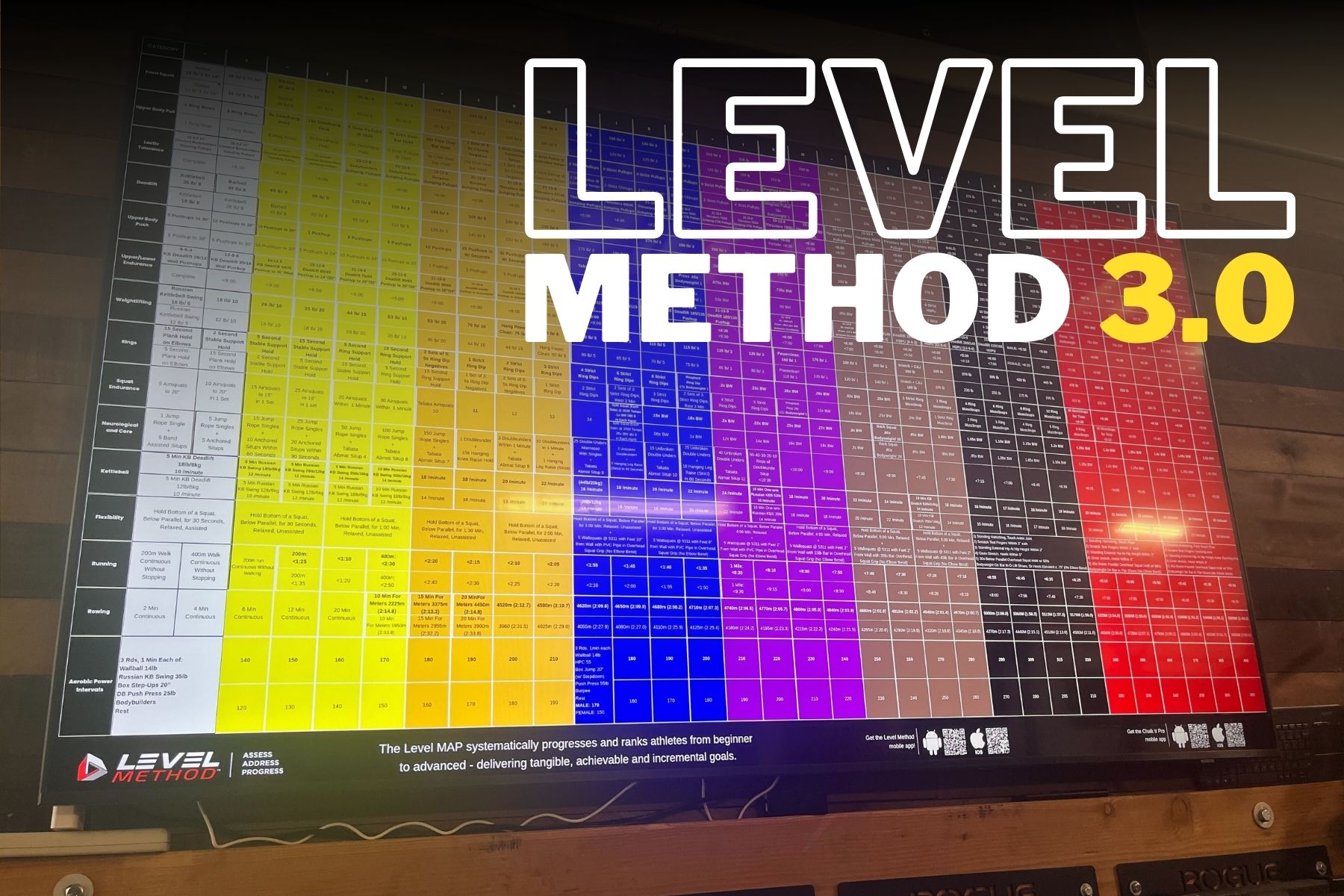
The MAP, the Method of Assessment and Progression, is what shows that constellation. It's not a leaderboard rank. It's not a single number. It's your fingerprint.
If your gym has shown you your MAP, take a long look at it. The shape of it tells you what you've trained, what you haven't, and where the most progress is available to you over the next year. The flatter your MAP, the more rounded your training has been. The spikier it is, the more it reveals about how you've spent your time.
There's no "correct" shape for a MAP. Yours reflects your life and your history. The point is not to flatten it. It's to read it, train against it, and watch it change over time.
Most members never get to see anything like this in fitness. You should know that what you're looking at is rare, and worth paying attention to.
Your Workout Isn't "the Blue Workout"
Most members have never had this explained clearly.
Even if your gym writes "Blue Level" next to your name, you are not doing "the Blue Level workout." Not really.
Here's what's actually happening: the class is still doing one shared workout. Same hour, same coach, same training goal.
But the important pieces of that workout can be matched to where you are.
If the workout has a deadlift piece, your coach may use your deadlift level to choose the right version. If it has a pulling piece, your pull level may matter. If it has rowing or conditioning, the relevant capacity category may shape what version fits you best.
So if you're Blue Level overall, but stronger in one category and less developed in another, your coach has a better reference point than "Rx or Scaled."
That does not mean the system is inventing a custom workout from scratch for every person in class. It means the shared workout has better guardrails. The coach can match the relevant pieces to the person standing in front of them.
When members understand that, the scaling conversation gets better. It is less about getting the easier version and more about getting the version that fits the goal of the workout.
That distinction matters. Pay attention to which elements feel right for you and which feel hard. Both signals are useful.
Progress the Whiteboard Couldn't See
If you've been "Scaled" on the whiteboard for six months, you might feel like you haven't moved.
But the whiteboard may not be showing the whole story.
The whiteboard is a label. It may not show that the load on the bar has gone up, your movement quality has improved, your pacing is steadier, or your capacity in one category has changed.
That is where the MAP is useful.
Ask your coach to walk you through what has actually moved. If the progress is there, you'll be able to see it. If it isn't there yet, the MAP can still show you the next specific target instead of leaving you with a vague feeling of being stuck.
This is one of the most useful things about training in a calibrated system: the conversation gets more specific. You stop asking only, "Am I Rx yet?" and start seeing what is actually changing, what still needs work, and what the next step looks like.
How to Read Your Own Progress
Three things you can do this week.
Ask your coach what level you are in each category. Not "your level" overall. The breakdown. Where are you in your deadlift? Where are you in your push? Rowing? Gymnastics? The breakdown is the useful part.
Ask what the next level looks like in your weakest category. Not your strongest. Your weakest. That's the category where the most untrained capacity is available to you. The next level there is usually the most accessible big win in your fitness over the next 6 to 12 months.
Notice when a workout fits. When a session feels demanding-but-doable, when you finish hard and recover well, when a weight is heavy enough to challenge you but you're not grinding under it for safety, that's the system working. Tell your coach when sessions feel like that. Tell them when they don't. That feedback loop is how the calibration gets better for you specifically.
Your coach is the one who reads the system on your behalf. They know you. They see you train. The system gives them a calibrated reference so what they're seeing in you stacks consistently across thousands of members. Your job is to ask, train, and notice.
Talk to Your Coach This Week
The short version:
You are not just a name in a column on a whiteboard. You have a level in every category your gym measures. Your workout is matched to the human standing there, not just sorted into a tier. There may be more going on than the label suggests. The system has been tracking the whole time.
Talk to your coach about your levels this week. Ask what your weakest category is. Ask what the next level looks like.
That conversation is what this whole system was built for.
If you found this guide and your gym doesn't run Level Method, we built a version for individuals who train solo or at a gym that doesn't have us yet. You can find it at levelmethod.com/individual.
If you're a gym owner reading this and want to know how the system works on your side, start at How It Works.